Sectors
Industrial brushes for the food industry
Food
Sector Context
The food industry is one of the industrial environments with the highest demands regarding hygiene, safety, and contamination control. Food production lines—from processing to packaging—require systems that keep equipment, surfaces, and products free of contaminating residues.
Technical industrial brushes play a key role in multiple processes such as: machinery cleaning and maintenance, product handling, transport, sealing, and fixing. Their functions range from equipment cleaning to the controlled handling of delicate products.
Food processing plants operate with high production volumes and continuous cycles, meaning that any accumulation of residue or cross-contamination can affect the quality of the final product, causing production downtimes or even generating health incidents. Therefore, machinery manufacturers and maintenance managers seek brushing solutions that combine mechanical efficiency, food safety, and durability.
Another critical factor is the diversity of processed products: fruits, vegetables, meat, fish, bakery, dairy products, or prepared foods. Each of these segments requires brushing solutions adapted to the product’s characteristics of fragility, moisture, or abrasive sensitivity.
Furthermore, the food industry is subject to strict regulations regarding food contact, materials used in equipment, and the ease of cleaning components.
Regulations such as Regulation (EU) No 10/2011 on plastic materials intended to come into contact with food, FDA (Food and Drug Administration) recommendations, or food safety systems like HACCP (Hazard Analysis and Critical Control Points) dictate the design of the industrial brushes used in these facilities.
In this context, industrial brushes designed specifically for food applications improve facility hygiene, optimize transport processes, and increase production line efficiency, while complying with the sector’s regulatory demands.
Brushing Applications in the Food Industry
Cleaning of food conveyor belts
Conveyor belts are one of the most critical elements in food processing lines. During transport processes, food scraps, dust, grease, or moisture accumulate, which can affect both hygiene and the proper functioning of the line.
Different types of brushes are used to continuously clean the surface of conveyor belts:
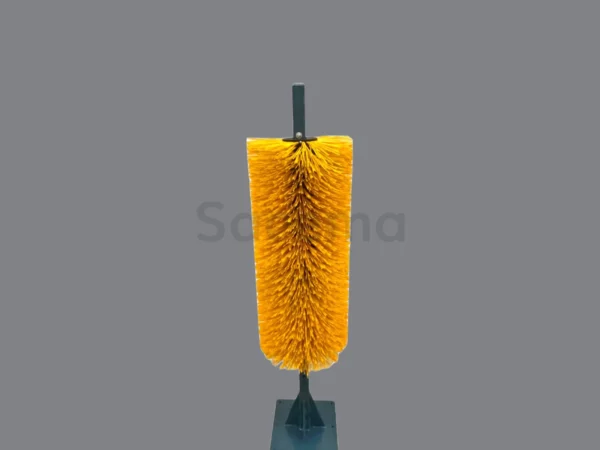
Cylindrical brushes are the main protagonists in the cleaning of transport elements. Mounted on our belt cleaner system, they provide continuous cleaning on moving elements.
On the other hand, when cleaning from another angle is required, we also have belt brushes, which, installed in our transverse belt cleaning system, adapt to all kinds of circumstances within the line.
These brushes can be installed at strategic points in the transport system to remove residues before they accumulate or stick to the belt. It is also possible to install them on the return side of the belt to ensure it arrives free of residues at the start of the route.
The most commonly used filament in these applications is usually food-grade nylon (PA). In applications where more aggressive cleaning is required, PBT filaments can also be used.
This type of solution reduces manual cleaning tasks, improves process hygiene, and increases the lifespan of conveyor belts.
Delicate product transport
In many food processes, it is necessary to transport fragile or delicate products, such as fruits, eggs, bread, or pastries. In these cases, industrial brushes are used as transport surfaces that allow the product to be moved smoothly, preventing damage or deformation.
Spiral brushes mounted on shafts or soft-filament cylindrical brushes create a flexible surface that cushions contact with the product. This is especially useful in fruit sorting lines or egg handling systems.
For these types of applications, very soft filaments are used, such as natural hair (horsehair or vegetable fiber) and fine nylon, which provide a flexible and non-abrasive transport surface.
Using brushes instead of rigid surfaces reduces the percentage of damaged product, improving the final quality of the process.
Processing equipment cleaning
Food processing equipment, such as slicers, peelers, sorters, or dispensers, generate residues during operation. These residues can accumulate in hard-to-reach areas and affect machine performance.
Custom-designed technical brushes allow specific components of these machines to be cleaned during operation or during maintenance cycles.
Depending on the machine’s design, options such as the following can be used:
Cylindrical brushes, which perform a constant cleaning function and can, depending on the distribution of their filaments, help evacuate debris in hard-to-reach areas within the production equipment.
Strip or table brushes, which usually work statically, guiding the accumulating residues and sweeping them away, generally taking advantage of the equipment’s own movement.
Furthermore, a custom solution designed for the specific needs of the processing equipment can be used.
The filaments are selected based on the type of residue to be removed and with the goal of facilitating its traceability. In food applications, it is common to use FDA-approved PBT or food-grade nylon, which combine mechanical resistance with compatibility with industrial cleaning processes.
Integrating brushes into processing equipment keeps systems cleaner for longer and reduces maintenance downtime.
Packaging machine sealing
In food packaging machines, it is essential to prevent the entry of dust, particles, or drafts that could affect the packaging sealing process.
Strip-type brushes are frequently used as flexible sealing elements in machinery doors, passage openings, or product entry and exit areas.
These brushes create a physical barrier that allows the product or packaging material to pass through while preventing the entry of external contaminants.
Defrosting in cold rooms
Cold storage and processing facilities, such as cold rooms or freezing tunnels, can generate frost and ice build-up on different equipment components.
A variety of technical brushes designed for low-temperature environments are used to remove frost from surfaces such as evaporators, rollers, or conveyor belts.
In these cases, filaments must maintain their flexibility even at very low temperatures. The most commonly used materials are usually technical nylon, which offers resistance to moisture and thermal changes.
The use of brushes in these systems maintains the performance of the cooling equipment and prevents operational problems caused by ice accumulation.
Regulations and Materials for Brushes in the Food Industry
Brushes used in the food industry must comply with a series of regulatory and technical requirements related to product safety and equipment hygiene.
One of the most important aspects is the use of food-contact-approved materials. In Europe, Regulation (EU) No 10/2011 establishes the requirements for plastic materials intended to come into contact with food. This regulation defines chemical migration limits and authorized substances to ensure that materials do not transfer compounds to the food.
In the United States, the FDA (Food and Drug Administration) regulates materials that can be used in contact with food. In the manufacturing of our industrial brushes, we use filaments certified in accordance with FDA recommendations to guarantee compatibility with food applications.
Another relevant aspect is the chemical resistance of the materials. Food processing plants frequently use cleaning and disinfection products that may have varying pH levels or contain aggressive chemical agents. Therefore, brush filaments and bases must be resistant to these products to ensure their durability.
In certain industrial environments, it may also be necessary to consider ATEX certification, especially in areas where there is a risk of explosive atmospheres due to the presence of combustible dust (for example, in flour or sugar processing facilities). In this case, our antistatic or conductive filaments could be of interest.
Technical Solutions Table
| Proceso | Problema | Cepillo recomendado | Filamento |
|---|---|---|---|
| Envasado | Polvo en sellado | Cepillo listón en tira | PBT FDA |
| Transporte | Producto delicado | Cepillo espiral suave | Pelo natural |
| Limpieza cinta | Residuos de alimento | Cepillo cilíndrico limpieza | PBT alimentario |
| Procesado | Acumulación de restos | Cepillo técnico a medida | Nylon FDA |
| Cámaras frío | Escarcha en rodillos | Cepillo cilíndrico técnico | Nylon resistente frío |
Related Products


Frequently Asked Questions about brushes in the food industry
What materials are used in brushes for food contact?
The most common are polypropylene (PP), nylon (PA), and certain natural filaments certified for food applications.
Can industrial brushes be used in washing or cleaning processes with water?
Yes. Many brushes are designed to withstand cleaning processes with water, detergents, or disinfectants used in the food industry.
Can custom brushes be manufactured for food machinery?
Yes. It is common to design specific brushes adapted to the geometry of the machine or the process.
What advantages do brushes have over other cleaning systems?
They allow for continuous cleaning during machine operation and reduce maintenance downtime.
Can brushes be used in cold rooms?
Yes, as long as filaments designed to maintain their flexibility at low temperatures are used.