Applications
Cleaning
Technical definition
Cleaning with industrial brushes is a mechanical process designed to remove residues, particles, dirt, or contaminants present on surfaces, parts, or equipment within industrial processes.
This function is based on the premeditated impact of the filaments or wires of the brushes that come into contact with the material or surface to be treated, allowing to detach and descale impurities without damaging the product, the surface, or the equipment.
Technical brushes are widely used for the purpose of cleaning surfaces in industrial production lines, both automated and non-automated, as well as in transport systems, material processing industries, and machine components.
Their main function is to work so that surfaces remain free of contaminants that may affect the operation of the equipment, the quality and finish of the product, or the fulfillment of technical requirements.
In demanding industrial environments, cleaning with technical brushes is an efficient, continuous, and adaptable solution to different configurations of industrial processes. It allows maintaining stable processes, reducing downtime, and avoiding accumulations of residues on the parts or in the process that could cause mechanical failures or problems due to excess dirt.
Types of brushes for cleaning industrial surfaces
There are multiple brush configurations specifically designed to perform cleaning tasks in industrial processes. The selection of the brush type depends on the type of surface, the nature of the residue, the process speed, and the environmental working conditions, and mainly on the available space and its integration with the process.
The most common filament materials are synthetic ones: Polyamides (PA) in all their variants, polypropylene, PBT polyester, metallic wires, and natural ones (horsehair, tampico, etc.)
| Brush type | Main working method | Common filament | Format |
|---|---|---|---|
| Cylindrical brush | Perpendicular cleaning to the surface | PA, PBT, polypropylene, metallic | Custom-made. Shaft mounted |
| Disc brush | Spot cleaning on rotating equipment | PA, PBT, polypropylene, metallic | Custom-made. Mounted on a flange |
| Flat brush | Static cleaning, without motorization | PA, PBT, polypropylene, metallic | Custom-made. Mounted on a support |
Cylindrical brushes for cleaning
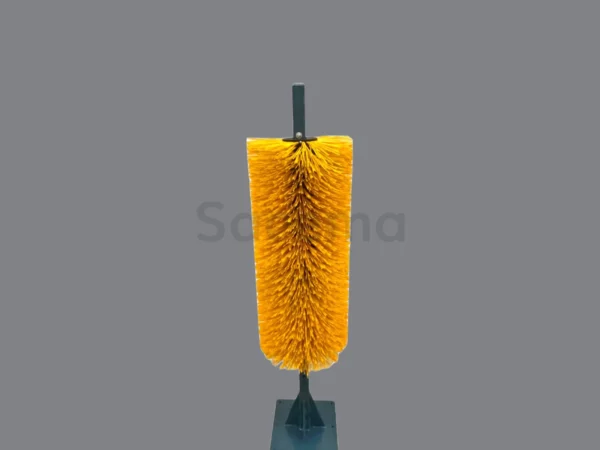
Cylindrical brushes are one of the most used solutions for cleaning in industrial machinery. Their design allows for continuous cleaning through rotation, which facilitates the removal of accumulated residues on moving surfaces.
The most common working method is perpendicular to the surface, working along its entire length and directing the residue towards the plane perpendicular to the working one.
They are commonly used on the return of conveyor belts, parts or food processing lines, product sorting systems, and material handling or movement machinery, etcetera. The uniform contact of the brush with the surface allows removing dust, product remains, or accumulated particles from the working surface.
The most used filaments in this type of brushes are nylon, polypropylene, or PBT, materials that offer good resistance to wear and to different environmental conditions.
Disc brushes for localized cleaning
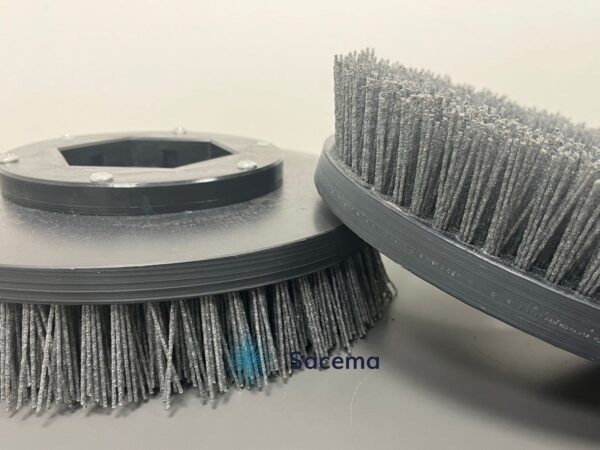
Disc brushes are used when cleaning must be carried out at specific points or on rotating surfaces. This type of brush allows concentrating the cleaning action in specific areas, which is common in industrial equipment where access is limited.
Machines are also designed with disc brushes instead of a cylinder when the surface to be cleaned is very large and there would be problems of excessive bending in a single cylindrical brush.
They are used in surface treatment machinery, polishing systems, parts preparation equipment, or component cleaning prior to subsequent processes.
Depending on the type of residue to be removed, standard nylon filaments (PA6) or metallic filaments that increase the cleaning capacity can be used.
Flat brushes for large surfaces
Flat brushes are used to clean surfaces when static work is desired, without a motorization that applies a movement of the brush. Their design allows covering a larger contact area and performing uniform cleaning.
They are common in handling processes for sheets, industrial panels, composite materials, or flat surfaces that require removing dust or particles prior to subsequent phases of the process.
Applications by sector
Cleaning with industrial brushes is a solution widely used in multiple productive sectors and all types of industries. Its ability to integrate into automated processes allows maintaining surfaces and equipment in optimal operating conditions.
Food industry
In the food sector, cleaning conveyor belts, product handling equipment, and contact surfaces is fundamental to guarantee the hygiene of the productive process.
Industrial brushes are used to remove food remains, particles, or residues that may accumulate during production. This contributes to maintaining the sanitary conditions required in the machines and prevents cross-contamination between products.
Water treatment and WWTP
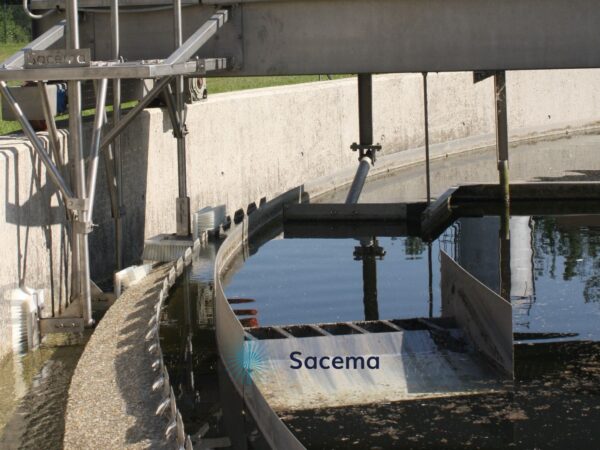
In water treatment plants and purification stations, industrial brushes are used to clean elements such as decanters, filters, or grids that accumulate solid residues during the purification process.
Cylindrical or rotary brushes allow removing these residues continuously, avoiding obstructions and guaranteeing the efficient operation of the equipment.
Glass industry
During glass manufacturing or handling, it is necessary to remove dust, particles, or material remains prior to subsequent processes such as tempering, laminating, or coating.
Technical brushes allow cleaning glass surfaces without damaging them, guaranteeing that subsequent processes are carried out in optimal conditions, especially in all versions of double construction glass.
In the renewable energy industry, technical brushes are commonly used for cleaning solar panels.
Metallurgical and metal industry
In steelmaking processes, cleaning with brushes is used to remove chips, metallic dust, or residues generated during part rolling processes to avoid encrustations and in machining with machine tools.
This process helps to prepare the parts for subsequent operations such as surface treatment, painting, or assembly.
Cleaning machines: sweepers and scrubbers
All professional cleaning machines, that is, both industrial and street sweepers and scrubbers, have industrial brushes to perform the cleaning.
Technical selection of the cleaning brush
Choosing the right brush for an industrial cleaning application requires analyzing different technical parameters related to the process and the working environment.
The first aspect to consider is the type of surface to be cleaned. Metallic, plastic, glass, or composite surfaces present different levels of resistance and may require more or less aggressive filaments.
The rotation or movement speed of the material also influences the brush selection. In high-speed processes, it is necessary to ensure that the brush maintains a stable contact without generating vibrations or excessive wear.
Working temperature is another relevant factor, especially in industrial processes where surfaces can reach high temperatures. In these cases, it is necessary to select heat-resistant filaments.
Chemical compatibility and working with water is also very important in its selection process to avoid damage from chemical degradation in acidic or alkaline environments.
In certain applications, specific regulatory requirements must also be considered. For example, in the food industry, it is necessary to use materials compatible with sanitary regulations, while environments with explosion risk may require solutions compatible with ATEX regulations, which are basically brushes where it is ensured that the filaments will not produce sparks in their work, and there are very few options available.
Finally, its own geometry: the available space, the traction for anti-rotation, the degree of aggressiveness of the filament (selecting the free length of the filament, its arrangement and section), must be adapted to the type of residue to be removed, ensuring effective cleaning without damaging the treated surface.
Related products


FAQ
What type of brush is used to clean conveyor belts?
Cylindrical brushes are one of the most used solutions for cleaning conveyor belts. Their rotary movement allows removing accumulated residues continuously without stopping the production line.
At Sacema, we also have complete equipment to integrate brushes for cleaning conveyor belts such as belt cleaners, transversal cleaner, or heavy duty cleaners for heavy industry.
What filament is best for industrial cleaning?
The most common filaments for industrial cleaning are synthetic ones, especially polyamides in their various variants, or polypropylenes and polyester in very humid environments. The choice depends on the type of surface, the required level of abrasiveness, and the working conditions.
Can custom cleaning brushes be manufactured?
Yes. Practically all industrial brushes are custom-made to adapt to the specific dimensions and requirements of each machine or productive process, with the exception of the brushes for sweeper and scrubber machines, for which the standard spare part is manufactured.
Do industrial brushes require maintenance?
Although industrial brushes are designed to offer a long service life, it is advisable to periodically check the condition of the filament and replace the brush when wear may affect the effectiveness of the cleaning.
As the wear of the filaments advances, they will progressively shorten, increasing their rigidity in the process and worsening their performance by becoming increasingly hard.