Applications
Fixing
Technical definition
Fixing using industrial brushes is a technical solution that allows delicate materials, parts, or products to be stabilized in steady positions throughout the industrial production process. This is achieved thanks to the flexibility of the filaments which, by exerting a controlled and dynamic pressure, provide a stable hold on the surface of the transported materials.
Unlike fixing systems based on rigid or mechanical elements, the brush fixing system maintains the material in position while absorbing small variations in shape, as well as vibrations derived from transport.
Fixing brushes are commonly used in automated machinery, within production or material handling lines, where it is necessary to stabilize parts during operations such as cutting, inspection, transport, or processing.
It increases the stability and precision of the production line while protecting the product surfaces.
Types of Brushes
Types of brushes for fixing materials in industrial processes The technical brushes used for fixing parts can adopt different configurations depending on the type of product, the type of machinery, and the contact pressure required to maintain the material in its position.
These brushes are also offered as a customized technical solution, custom-made with the aim of adapting to the particular circumstances within each production environment.
| Brush type | Main application | Recommended filament | Format |
|---|---|---|---|
| Fixing strip brush | Stabilization of parts in guides or belts | Nylon, polypropylene | Aluminum profile |
| Cylindrical pressure brush | Fixing of materials in rotary machinery | Nylon, PBT | Custom-made |
| Fixing disc brush | Localized pressure on parts | Nylon | Metallic core |
| Flat pressure brush | Fixing of wide surfaces | Nylon, polypropylene | Metallic base |
Strip brushes for fixing
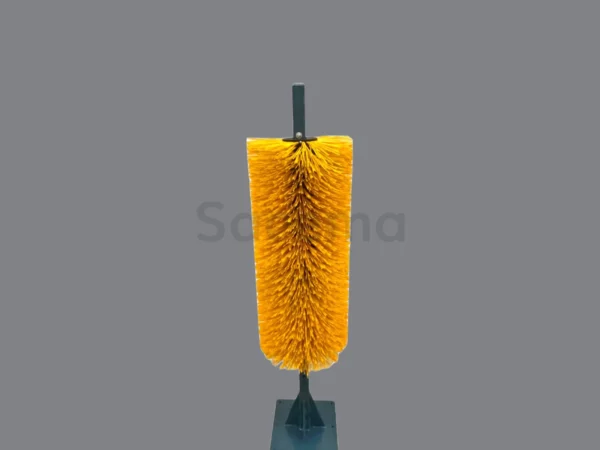
Cylindrical brushes can be used to fix materials while they move through the machinery. The brush rotates on an axis while exerting a controlled pressure that keeps the material in contact with the transport surface.
This system is used in machinery where it is necessary to stabilize materials during handling, sorting, or transport processes.
Cylindrical brushes are usually custom-made to adapt to the dimensions of the machine and the process requirements.
Cylindrical pressure brushes
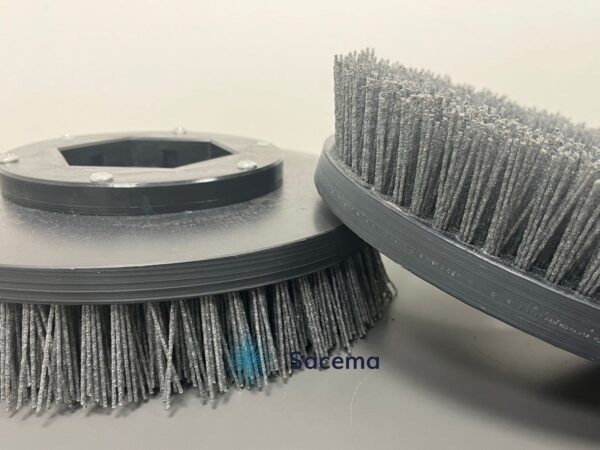
Disc brushes allow pressure to be applied to specific points of a part to keep it in position during the industrial process.
This type of brush is used in parts handling systems, assembly equipment, or automated machinery.
Disc brushes for localized fixing
Disc brushes allow pressure to be applied to specific points of a part to keep it in position during the industrial process.
This type of brush is used in parts handling systems, assembly equipment, or automated machinery.
Its compact design facilitates its integration into machinery where space is limited or where fixing must be carried out in specific areas of the product.
Flat brushes for surface stabilization
Flat brushes can be used to fix or stabilize larger materials, such as panels or sheets. Their design allows them to cover a wider surface and exert a uniform pressure on the material.
This type of brush is frequently used in panel handling machinery, automated production lines, or surface treatment equipment.
Applications by Sector
Fixing using industrial brushes is especially useful in numerous sectors where it is necessary to keep materials or parts stable during manufacturing or handling processes.
Packaging industry
In automated packaging lines, fixing brushes are used to stabilize containers, boxes, or products as they go through processes such as labeling, printing, packaging, or inspection.
The gentle pressure of the brush allows the product to be kept in position without stopping the line flow.
Food industry
In the food sector, brushes can be used to keep products stable during handling or transport processes on conveyor belts.
The gentle contact of the filament prevents damage to the product and allows a continuous flow to be maintained in the production line.
Glass industry
During the handling of glass pieces or flat glass, fixing brushes help to keep the material in position as it moves through the machinery, ensuring a smooth flow and preventing sudden movements that could cause breakage.
Plastics industry
In manufacturing processes for plastic parts, industrial brushes are used to fix or stabilize components during handling, inspection, or assembly operations.
Industrial automation
In automated machinery, brushes can be used to keep parts in position during machining, assembly, or quality control operations.
Thanks to their flexibility, they allow adaptation to different types of products without the need for specific rigid fixing systems.
Technical Selection
The selection of an industrial brush for fixing applications must be carried out taking into account several technical factors related to the material and the production process.
One of the most important aspects is the weight and geometry of the material to be fixed. Heavier parts or those with irregular shapes may require denser filaments or specific brush configurations.
It is also necessary to consider the pressure that the brush must exert on the material. The length and stiffness of the filament determine the contact force and must be adjusted to maintain the stability of the product without damaging it.
The process speed is another factor that influences brush selection. In high-speed lines, it is important to ensure that the brush can maintain contact with the material without causing vibrations or premature wear.
The environmental conditions of the process, such as temperature, humidity, or the presence of chemical products, must be taken into account to select the appropriate filament material.
Finally, the brush installation system must adapt to the machinery design to ensure safe and efficient integration.
The geometry of the equipment will determine the most suitable type of brush, being able to use cylindrical, flat, strip, disc brushes, or custom-made technical solutions.
Related products


FAQ
What are industrial fixing brushes used for?
Can brushes fix materials without damaging them?
Can fixing brushes be custom-made?
Yes. Brushes used for fixing are usually custom-made to adapt to the dimensions of the machinery and the specific requirements of each industrial process.
What filament materials are used in fixing brushes?
The most commonly used filaments are nylon, polypropylene, and PBT, materials that offer a good combination of flexibility, mechanical resistance, and durability in industrial environments.