Sectors
Industrial Brushes for the Glass Industry
Crystal and Glass
Sector Context
The crystal and glass industry encompasses a wide variety of industrial processes, from the manufacture of flat architectural glass to the production of packaging, technical glass, automotive glass, or decorative glass. All these processes share a common element: the need to handle, clean, and transport extremely delicate and scratch-sensitive surfaces.
During the different manufacturing stages—cutting, polishing, washing, tempering, laminating, or packaging—the glass must be kept free of particles, dust, abrasive residues, and contaminants that could compromise its quality. Even microscopic particles can cause visible defects in the final product, leading to production rejections or significant economic losses.
In this context, specialized industrial brushes play a fundamental role in different phases of the process. They are used both to clean glass surfaces and remove residues generated during machining, as well as to transport delicate pieces or seal machinery areas to prevent dust entry.
One of the main challenges in this sector is finding the balance between cleaning efficiency and softness of contact. Brushes must be effective enough to remove particles or residues but, at the same time, must avoid generating micro-scratches or marks on the glass surface.
Furthermore, glass production lines usually operate at high speeds and in demanding industrial environments, where equipment must withstand humidity, water, industrial detergents, and temperature variations. Therefore, the materials used in the brushes must offer high mechanical resistance, dimensional stability, and durability.
In recent years, the increased quality demanded in sectors such as architecture or automotive has also driven the demand for technical brushing solutions that make it possible to maintain increasingly strict finishing standards.
Brushing Applications in the Crystal and Glass Industry
Cleaning of glass sheets before processing
Before carrying out processes such as tempering, laminating, or screen printing, glass surfaces must be completely free of dust or other particles released during the cutting process.
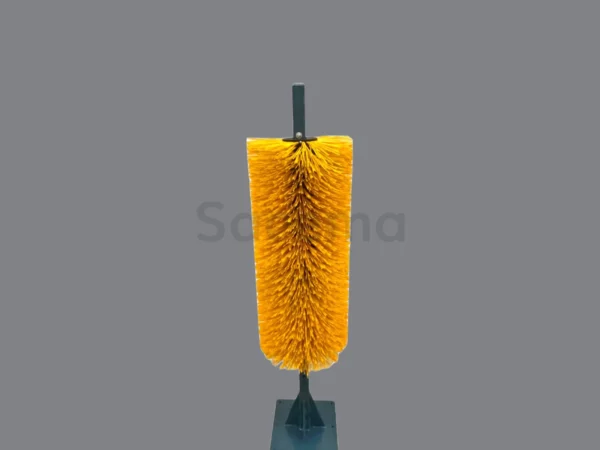
In glass washing machines, cylindrical brushes are one of the most important elements to ensure uniform cleaning across the entire surface. These brushes normally work in combination with water and industrial detergents to remove any particles adhering to the glass.
The filaments used in these applications are usually high-quality nylon (PA), as it offers a good balance between softness and cleaning capacity. In particularly delicate applications, softer filaments specifically designed to avoid any risk of micro-scratches can also be used.
The correct selection of the brush in these machines is essential to ensure the final quality of the glass before critical processes.
Glass transport in production lines
During the glass manufacturing or transformation process, the sheets must move along different equipment and workstations.
In many cases, industrial brushes are used as a transport surface.
Table-type lath brushes, for example, provide firm support to reduce friction when moving through the various workstations.
It is also possible to use cylindrical brushes in series, forming a roller conveyor that propels the glass sheets to the next point on the line.
This system is especially useful when handling large-sized glass or very thin sheets, which can break or scratch if transported on rigid surfaces.
The most commonly used filaments in these applications are usually technical nylon or special low-abrasion filaments, which guarantee soft contact with the glass surface.
The use of brushes for transport also improves glass stability during movement, avoiding vibrations or sudden jolts.
Cleaning glass dust after cutting
The glass cutting process generates fine dust particles that can adhere to the surface of the pieces. These particles can affect both the final finish and subsequent processes, such as laminating or gluing.
Rotary cylindrical brushes are used to remove this dust immediately after cutting. This prevents the particles from moving to other parts of the production line.
Depending on the type of glass and the level of dirt, technical nylon or polypropylene filaments can be used, selected to offer effective cleaning without generating abrasion.
This type of solution keeps surfaces clean throughout the production process and reduces defects in the final product.
Polishing and surface finishing
In some technical or decorative glass manufacturing processes, industrial brushes are used to perform surface finishing or light polishing operations.
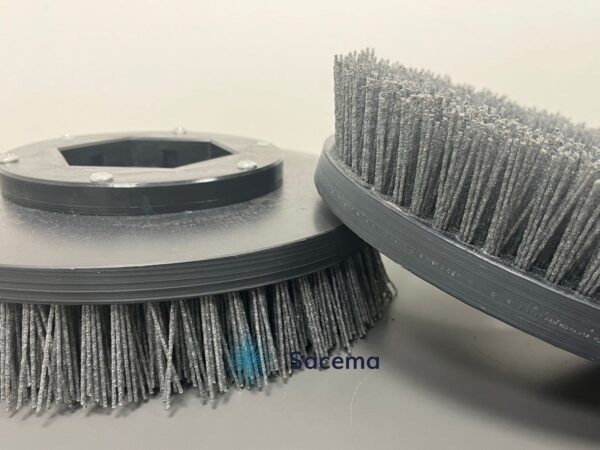
Disc brushes are an interesting option in polishing processes because they concentrate their movements in a specific area of the material.
In these applications, brushes can work in combination with abrasive compounds or polishing liquids to improve the glass finish or remove small imperfections generated during machining.
The brushes used in these processes usually incorporate abrasive nylon filaments or special technical fibers, designed to provide a uniform finish without damaging the piece.
This type of solution is mainly used in the manufacture of technical glass, optical glass, or special components.
Machinery sealing and dust protection
Glass manufacturing facilities often generate large amounts of fine dust from cutting or machining the material. This dust can affect the operation of sensitive equipment or contaminate other areas of the production line.
Strip brushes are frequently used as flexible sealing systems in machinery, industrial doors, or passage openings.
These brushes allow the passage of materials or components while acting as a barrier against dust and drafts.
The filaments used are usually polypropylene or nylon, selected based on the required wear resistance and the environmental conditions of the facility.
Regulations and Materials in Glass Applications
Although the glass industry is not subject to the same sanitary regulations as sectors like the food industry, there are technical requirements related to final product quality and industrial safety.
One of the most important aspects in this sector is the proper selection of the filament material to avoid damage to the glass surface. The materials must offer a combination of softness, mechanical resistance, and dimensional stability.
Nylon (PA) is one of the most widely used materials due to its excellent wear resistance, flexibility, and resistance to water and chemicals used in glass washing processes.
Polypropylene (PP) is also used in certain applications where greater chemical resistance or lower moisture absorption is required.
In environments where aggressive chemicals or industrial detergents are used, it is essential that the filaments maintain their integrity and do not degrade over time.
Another important aspect is thermal resistance. Some stages of the glass manufacturing process may involve high temperatures, so the materials must be able to withstand these conditions without deforming.
Additionally, the brush design must adapt to the specific characteristics of each machine or process, ensuring uniform contact distribution and a long component lifespan.
Technical Solutions Table
| Process | Problem | Recommended Brush | Filament |
|---|---|---|---|
| Glass washing | Particles on surface | Cylindrical brush | Technical nylon |
| Transport | Risk of scratches | Roller conveyor | Soft nylon |
| Cutting | Glass dust | Cylindrical brush | Technical PP |
| Polishing | Surface imperfections | Disc brush | Abrasive nylon |
| Machinery | Dust entry | Strip brush | PP or nylon |
Related Products


FAQ
Can brushes scratch the glass?
If the proper filament is selected, industrial brushes are designed to clean or transport glass without generating scratches.
What filaments are commonly used in glass applications?
The most common are technical nylon, soft nylon, and polypropylene.
Can brushes be used in glass washing machines?
Yes. Cylindrical brushes are an essential component in many industrial glass washing systems.
Can brushes work with water and industrial detergents?
Yes. Many filaments are designed to withstand wet conditions and the chemicals used in glass washing.
Can specific brushes be manufactured for a glass machine?
Yes. It is common to design custom brushes to adapt to the geometry and operation of specific equipment.