Applications
Transport
Technical definition
Transport using industrial brushes is a technical solution used to move, guide, or assist the movement of materials, parts, and products within automated industrial processes.
This function is based on controlled contact between the brush filaments and the surface of the material, allowing guidance or propulsion without generating excessive friction or damaging the product.
Industrial brushes are frequently used as auxiliary elements in transport systems where it is necessary to move delicate materials, irregular parts, or products that require gentle contact during handling. Thanks to the flexibility of the filaments, brushes allow products to be transported while absorbing small positional variations or surface irregularities.
This type of solution is commonly integrated into material handling machinery, automated transport systems, and production equipment where controlled movement, surface protection, or improved process stability is required.
Types of brushes for transporting materials in industrial processes
Brushes used for transporting materials can adopt different configurations depending on the type of product, production line speed, and machine geometry.
| Brush type | Main application | Recommended filament | Format |
|---|---|---|---|
| Cylindrical brush | Gentle transport of parts or materials | Technical nylon, PBT, PP | Custom cylindrical core |
| Disc brush | Transport of parts in rotating machinery | Technical nylon, PBT, PP | Custom disc-shaped core |
| Belt-mounted brush | Specialized handling systems | Technical nylon, PBT, PP | Usually trapezoidal belt |
| Chain-mounted brushes | Specialized handling systems | Technical nylon, PBT, PP | Brush integrated into chain flights |
| Brush belt | Modular conveyor belt | Technical nylon, PBT, PP | Filaments directly tufted into modular belt sections |
Cylindrical brushes
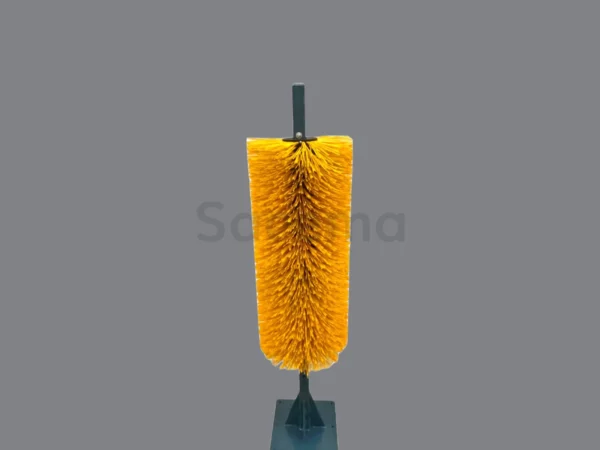
Roller or cylindrical brushes are used to transport materials smoothly and in a controlled manner within industrial systems. This type of brush rotates around an axis, allowing parts or products to move while supported by the filaments.
The flexible contact reduces friction and protects the material surface, which is especially useful when handling delicate or sensitive-finish parts.
Cylindrical brushes can be manufactured with different filament densities and adapted to the specific dimensions of the machinery.
The brush rotates together with the shaft and, through the filaments, drags the materials to assist their transport.
Disc brushes for point transport
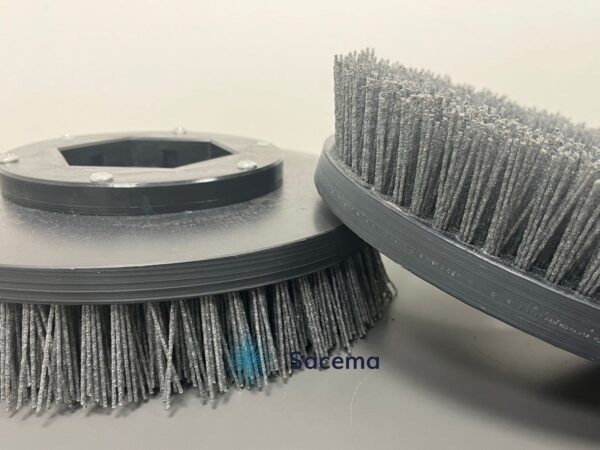
Disc brushes are used when product transport occurs at specific points in the process or when parts need to be directed toward precise positions.
This type of brush is integrated into rotating machinery or handling equipment where available space is limited. Its compact design allows dragging or moving parts without interfering with other machine components.
Technical brushes on belts
In specific industrial applications, technical brushes can be custom-designed to perform transport functions tailored to process requirements.
Filaments are tufted onto a trapezoidal belt, and these filaments drag the material according to the direction of belt movement.
These brushes can be integrated into automated machinery to move delicate parts, flexible materials, or products with complex geometries requiring gentle contact during handling.
This application is typical when elements need to be moved in a straight line or along a defined path.
Technical brushes on chains
This application is very similar to the previous one, but a chain is used as the base material.
Since chains are metallic, filaments cannot be directly inserted, so the system is configured with flight links.
Brushes (strip or table brushes) are mounted onto these flights.
These brushes can be integrated into automated machinery to move delicate parts, flexible materials, or products with complex geometries requiring gentle contact during handling.
This application is similar to belt systems and is used when elements need to move in a straight line or along a defined path dictated by the chain.
Brush belt
These brushes are systems in which filaments are added to modular conveyor belt sections. They can be integrated into automated machinery to move delicate parts, flexible materials, or products with complex geometries requiring gentle contact during handling.
This application is similar to belt systems, as it is used when elements need to move linearly, but in this case the entire belt acts as a single brush.
It is used in applications where the product is very delicate and needs to “float” over the brush belt.
Applications by sector
Transport using industrial brushes is used in multiple sectors where products need to be moved in a controlled manner within automated systems.
Food and pharmaceutical industry
In the food and pharmaceutical sectors, industrial brushes are used to transport delicate products such as tablets, medicines, fruits, vegetables, or processed foods without damaging their surface.
The soft filament contact allows these delicate products to be moved while remaining protected from impacts or excessive friction.
Automotive industry
In automated automotive production lines, industrial brushes can be used to move components through different stages of the process, especially painted body parts and interior accessories.
Brushes help maintain a continuous product flow while ensuring protection against impacts and scratches.
Glass industry
During the handling of flat glass or glass parts, transport brushes allow the material to be moved without damaging its surface. This solution is especially useful when handling large panels or sheets.
Aerospace and defense industry
In industrial processes for aerospace and defense, technical requirements for protection and finish are higher than in other sectors.
During different production stages, numerous handling and transport operations take place.
The use of brushes helps keep materials stable, prevents surface damage, and can even avoid chemical contamination by acting as a barrier between materials that could otherwise interact chemically.
Industrial automation
In automated part handling systems, industrial brushes allow products to be transported to workstations, inspection areas, or assembly points.
Thanks to their flexibility, brushes can adapt to different types of parts without requiring complex rigid mechanisms.
Technical selection of transport brushes
Selecting an industrial brush for transport applications must consider various technical factors related to the production process.
One of the most important aspects is the weight and geometry of the material to be transported. Heavier or irregularly shaped products may require higher filament density, thicker filaments, or specific configurations.
Some brushes combine different filament types and lengths within the same unit to achieve maximum customization and adaptability.
Production line speed also influences brush selection. In high-speed processes, it is essential to ensure that the brush maintains contact with the material without causing vibrations or excessive wear.
The type of product surface is another key factor. Delicate materials require soft filaments to prevent damage.
Environmental conditions such as temperature, humidity, or exposure to chemicals must also be considered when selecting the appropriate filament material.
Finally, integration into the machinery must match the equipment design, using cylindrical brushes, disc brushes, or more complex technical solutions such as belt-mounted, chain-mounted, or custom brush belt systems.
Related products




FAQ
What are industrial brushes used for in material transport?
Industrial brushes are used to move or guide materials within machinery or production lines, enabling smooth transport that protects product surfaces.
Can brushes transport delicate materials?
Yes, this is the most common application. Flexible filaments allow delicate products such as glass, food, or plastic parts to be transported without damage.
Can transport brushes be custom-made?
Yes. Industrial transport brushes are typically custom-manufactured to fit machine dimensions and specific process requirements.
What filaments are used in transport brushes?
The most common filaments are nylon, polypropylene, and PBT, as they provide a good balance of mechanical strength, flexibility, and durability in industrial environments.
Can brushes be used to prevent parts from stopping in automated processes?
Yes, this is another way of understanding the same application. Normally brushes move parts, but they can also assist transport in stages where parts tend to stop, such as transitions between conveyors, narrow sections, transfer units, or curves.
In these cases, the brush helps maintain movement.