Applications
Guiding
Technical definition
Guiding using industrial brushes is a technical solution used to maintain the position, alignment, maintain the trajectory of materials and products during their displacement within automated industrial processes.
This function is based on the controlled contact of flexible filaments that allow orienting the movement of the material without causing damage, blockages, or excessive friction.
Guiding brushes are commonly used in production lines where it is necessary to maintain the lateral stability of products to prevent moving parts from falling. The flexibility of the filaments of technical brushes allows adapting to small variations in position without generating sudden mechanical stress on the material or machinery, and without causing any damage, however small it may be.
Thanks to their capacity to absorb vibrations, tolerate misalignments, and reduce wear on contact surfaces, industrial brushes with flexible filaments are a widely used solution for guiding products in sectors such as packaging, food, material transformation, or industrial automation.
Types of brushes for guiding materials in industrial processes
The guiding of products using brushes can be carried out using different configurations of technical brushes depending on the type of material, the speed of the process, and the geometry of the machinery.
| Brush type | Main application | Recommended filament | Format |
|---|---|---|---|
| Strip brush | Lateral guiding on conveyor belts | Nylon, polypropylene, PBT | Custom-made |
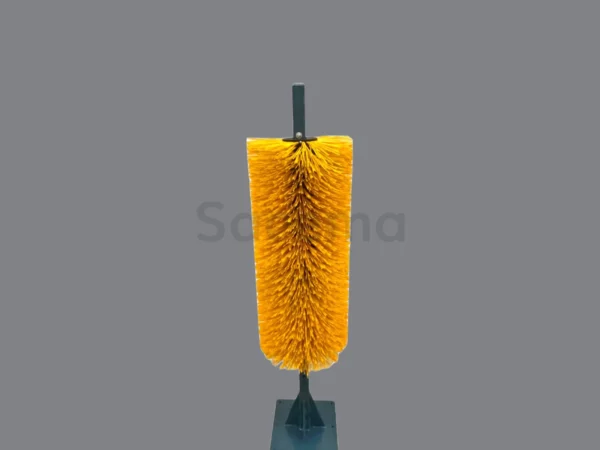
| Cylindrical brush | Guiding of moving parts | Nylon, PBT | Custom-made |
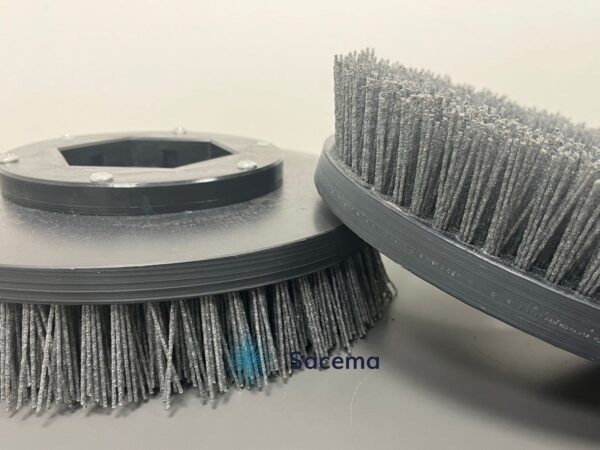
| Disc brush | Positioning of parts in rotating machinery | Nylon, polypropylene, PBT | Custom-made |
| Flexible belt brush | Centering of products in transport lines | Nylon, polypropylene | Flexible belt profile adjustable to complex geometry |
Strip brushes for lateral guiding
Strip or lath-type brushes are one of the most widely used solutions for guiding products on conveyor belts or automated transport systems. Their design allows installing continuous rows of filaments that exert gentle lateral pressure on the product, keeping it on the desired trajectory, at a relatively low cost.
These brushes are commonly used in packaging lines, product sorting, or material transport where it is necessary to avoid lateral displacement and products falling to the sides. The flexible contact of the filament allows correcting small deviations without causing damage to the product or generating excessive friction.
In addition, their profile system facilitates installation on machinery structures and allows adjusting their position according to the needs of the process and gaining many meters of guiding at a low cost.
Cylindrical brushes for guiding parts
Cylindrical brushes can also be used to guide moving products within industrial machinery. Thanks to their rotation, these brushes allow directing parts or materials towards a determined position while they move along the production line.
This type of solution is frequently used in sorting equipment, transport of small parts, or handling of products in automated lines.
Cylindrical brushes can be custom-made according to the shaft diameter, the working length, the available space for their integration, and the filament density necessary for the process.
The brush can be supplied alone or mounted with its shaft. In more developed cases, complete machines can be designed and manufactured to integrate the cylindrical brush into the industrial process to guide the parts.
Disc brushes for positioning
Disc brushes allow guiding or positioning parts in machinery where space is limited or where guiding must be carried out at specific points in the process.
Their compact format allows them to be installed on rotating shafts or lateral supports, facilitating contact with the part during its displacement. This type of brush is common in assembly machinery, part handling systems, or automation equipment.
Belt brushes as a guide for flexible materials
When working with flexible materials such as plastic films, sheets, or technical textiles, guiding using brushes allows maintaining the material aligned during its displacement.
These brushes usually use soft filaments that avoid damaging the material while correcting lateral deviations that could affect the productive process.
Likewise, they are used when the guiding is not straight and has to follow a complex geometry, since the base of the brush is flexible and allows adjusting to the base on which it is intended to be installed.
Applications by sector
Industrial guiding brushes are used in numerous sectors where materials or products must be kept aligned during their displacement in machinery or automated lines.
Packaging industry
In automated packaging and packing lines, the guiding of products is essential to guarantee that the containers are positioned correctly before processes such as labeling, filling, or sealing.
Lateral brushes allow maintaining the containers aligned on the conveyor belt and preventing jams or deviations that may affect the efficiency of the line, preventing them from falling to the sides of the conveyor belts.
Food industry
In the food sector, the guiding of products using brushes is used to direct food on conveyor belts towards processing, sorting, or packaging areas.
The smooth contact of the filament avoids damage to the product and allows maintaining a constant flow on the production line.
Glass industry
During the handling of flat glass or glass parts, it is fundamental to maintain the alignment of the material to avoid impacts or stress that may cause breakages.
Guiding brushes allow orienting the parts during their displacement, maintaining a soft contact that protects the glass surface.
Plastics industry
In plastic transformation processes, such as extrusion or sheet handling, brushes are used to guide the material during its displacement and avoid deviations that may affect the manufacturing process.
Industrial automation
In automated part handling systems, industrial brushes allow orienting products towards specific positions without the need for rigid mechanical systems.
This solution reduces the risk of damage to the parts and allows greater flexibility in machinery design.
In addition, it greatly facilitates absorbing small dimensional mismatches of the robot.
Technical selection of the guiding brush
The selection of an industrial brush for guiding must be carried out considering various technical factors related to the productive process.
One of the most important aspects is the type of material or product to be guided. Fragile materials or delicate surfaces require soft filaments that allow contact without causing damage.
It is also important to consider the speed of material displacement. In high-speed lines, it is necessary to guarantee that the brush can maintain stable contact without generating vibrations or premature wear.
The geometry of the machinery and the available space also influence the choice of the brush type. In some cases, linear strip brushes are used, while in others, cylindrical brushes or discs are required to adapt to the equipment design.
The environmental conditions of the process, such as temperature, humidity, or the presence of chemical products, must also be taken into account to select the suitable filament material.
Finally, the density and length of the filament must be adjusted to provide the necessary lateral pressure without interfering with the normal operation of the process.
In most cases, and the most common brush for guiding parts is the strip brush, since it is economical, the application rarely requires motorization, and it allows long parts to be taken out easily.
Related products


FAQ
What type of brush is used to guide products on a conveyor belt?
Strip brushes installed laterally on the conveyor belt are one of the most widely used solutions for guiding products due to their low operating and maintenance cost in relation to their working length. Their flexible contact allows maintaining the product aligned without generating excessive friction.
Can brushes guide delicate materials?
Yes. Industrial brushes can be manufactured with soft filaments that allow guiding delicate materials such as glass, plastic film, or food products without damaging them.
Can custom guiding brushes be manufactured?
Yes. Industrial brushes for guiding are usually custom-made to adapt to the geometry of each machine, including length, filament density, and fixing system.
Do guiding brushes cause wear on products?
Not when they are correctly selected. The use of suitable filaments allows exerting a controlled lateral pressure that maintains the position of the product without causing.