Sectors
Industrial Brushes for the Renewable Energy Sector
Renewable Energies
Sector context
The renewable energy sector encompasses different technologies aimed at generating energy from renewable sources, such as photovoltaic solar, thermal solar, wind, biomass, or hydroelectric energy. The growth of these installations has driven the need to develop increasingly efficient manufacturing, maintenance, and cleaning systems.
In this context, industrial brushes have applications across different stages of the value chain: component manufacturing, equipment assembly, facility cleaning, preventive maintenance, and surface treatment.
One of the most well-known applications is found in photovoltaic solar installations. The accumulation of dust, sand, pollen, or dirt on panels can reduce the amount of solar radiation reaching the photovoltaic cells and, therefore, affect the facility’s performance. Cleaning systems using brushes make it possible to automate and facilitate these operations without damaging the panel surface.
In the wind energy sector, brushes can be used both during the manufacturing and finishing of components and in specific maintenance operations. The large dimensions of blades, metallic components, and mechanical systems require technical solutions tailored to each application.
The working conditions of renewable energy installations also pose significant demands. Equipment can be exposed to solar radiation, humidity, dust, salinity, temperature changes, and aggressive outdoor environments for long periods.
For this reason, brush selection must take into account factors such as surface type, contact pressure, working speed, filament material, and resistance to environmental conditions.
A properly sized brushing solution allows for the automation of cleaning and maintenance operations, the protection of sensitive components, and the improvement of specific process efficiencies.
Brushing applications in renewable energies
Panel cleaning in large photovoltaic plants
Large solar plants require keeping thousands of panels in optimal condition. In these facilities, the accumulation of dust, sand, dirt, or any other residue is inconvenient when it comes to efficiently capturing solar radiation.
Performing these operations manually can involve high time and resource consumption.
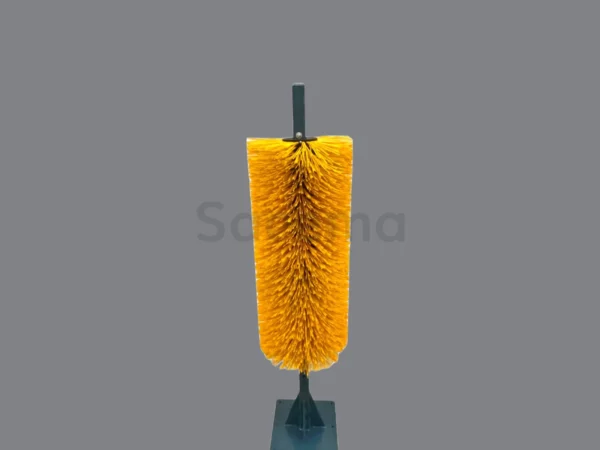
Long cylindrical brushes can be integrated into vehicles or automated cleaning systems to cover large panel surface areas in each duty cycle.
In these applications, the goal is to combine high cleaning capacity, low risk of abrasion, and resistance to continuous outdoor use.
Soft nylon filaments, technical fibers, or materials specially designed for cleaning delicate surfaces can be used depending on facility requirements.
Filament density, length, and diameter must also be selected taking into account contact pressure and the displacement speed of the cleaning system.
Manufacturing and finishing of wind turbine components
Manufacturing components for wind turbines includes various machining, sanding, cleaning, and finishing processes.
During these operations, particles, dust, or residue can be generated that must be removed prior to applying coatings, paints, or subsequent treatments.
Technical cylindrical, circular, or strip brushes can be integrated into automated lines to carry out cleaning and surface preparation tasks.
Depending on the material being treated, technical nylon filaments, abrasive fibers, or metallic filaments can be used.
Selection must be made considering the required finish and avoiding excessive material removal when working on technical surfaces.
Machinery cleaning and maintenance
Renewable energy component manufacturing facilities feature automated machinery that requires periodic maintenance operations.
Brushes can be installed on specific equipment to continuously remove dust, particles, or production waste.
Strip brushes, inserted strip brushes, cylindrical, or circular brushes can be used to protect guides, movement systems, passageways, or internal components.
Equipment sealing and dust protection
Strip brushes can be used as sealing elements in machinery used in renewable energy installations.
Their flexible design allows for closing gaps between moving components without restricting their movement.
They are particularly useful for reducing particle entry, protecting electrical or mechanical components, and preventing drafts.
The filament can be selected based on environmental conditions and the operating temperature of the equipment.
Standards and materials in renewable energy applications
Brush selection for the renewable energy sector must consider the safety and maintenance requirements of the machinery in which they are integrated.
In outdoor installations, materials are exposed to ultraviolet radiation, humidity, rain, dust, and temperature fluctuations. For this reason, it is important to use filaments with adequate resistance to aging and environmental conditions.
Polypropylene (PP) offers good chemical resistance and low moisture absorption, making it suitable for various outdoor applications.
Nylon (PA) provides high mechanical and wear resistance, making it common in technical brushes and cleaning systems.
In applications where the brush comes into contact with delicate surfaces, such as the glass on photovoltaic panels, priority must be given to selecting a low-abrasion filament and correctly adjusting the working pressure.
For metallic surface preparation processes, steel, stainless steel, or brass can be used, depending on the material to be treated and the required finish.
In certain industrial facilities, it may also be necessary to consider ATEX-related requirements, especially when potentially explosive atmospheres derived from combustible dust or other materials exist.
Technical solutions table
| Process | Problem | Recommended brush | Filament |
|---|---|---|---|
| Photovoltaic | Dust on panels | Soft cylindrical brush | Soft nylon |
| Wind power | Component cleaning | Technical cylindrical brush | Technical nylon |
| Metal | Rust and dirt | Wire circular brush | Steel |
| Machinery | Dust ingress | Sealing strip brush | Technical PP |
Related Products


Frequently asked questions
Can brushes be used to clean solar panels?
Yes. There are brushes specifically designed to clean photovoltaic surfaces using soft, low-abrasion filaments.
Can a brush scratch a photovoltaic panel?
No, provided that an appropriate configuration of filaments and machinery is used.
What filament is used to clean solar panels?
Soft nylon filaments, technical fibers, or other low-abrasion materials suitable for delicate surfaces are commonly used.
Can brushes be used in machinery for manufacturing wind components?
Yes. They can be integrated into cleaning, surface preparation, finishing, and component protection processes.
Can custom brushes be manufactured for automatic cleaning systems?
Yes. Dimensions, density, length, and filament type can be tailored to system requirements.
Are brushes resistant to outdoor conditions?
Depending on the material selected, they can be engineered to operate in the presence of humidity, solar radiation, dust, and temperature variations.